
-
Regular price $146.00Regular priceUnit price per
$208.57Sale price $146.00 -
Regular price $156.00Regular priceUnit price per
$222.86Sale price $156.00 -
Regular price $146.00Regular priceUnit price per
$208.57Sale price $146.00 -
Regular price $146.00Regular priceUnit price per
$208.57Sale price $146.00 -
Regular price $146.00Regular priceUnit price per
$208.57Sale price $146.00 -
Regular price $146.00Regular priceUnit price per
$208.57Sale price $146.00 -
Regular price $139.00Regular priceUnit price per
$198.57Sale price $139.00 -
Regular price $139.00Regular priceUnit price per
$198.57Sale price $139.00 -
Regular price $159.70Regular priceUnit price per
$228.14Sale price $159.70






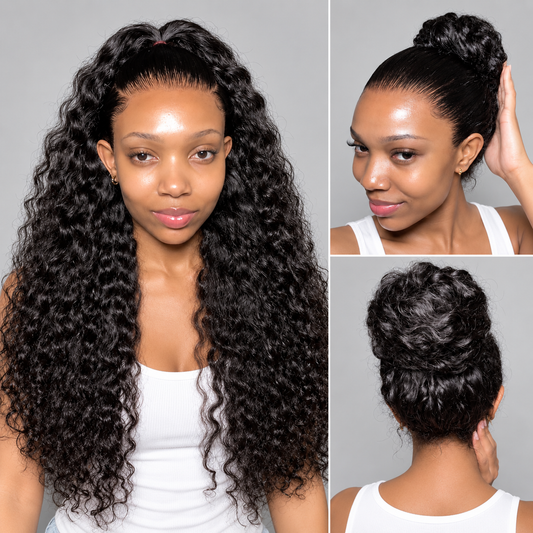

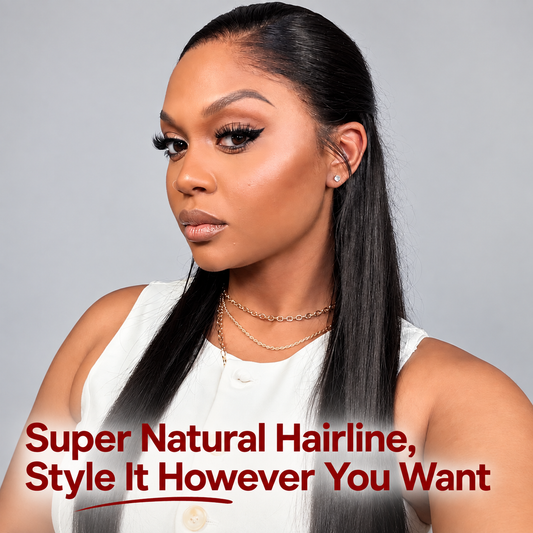
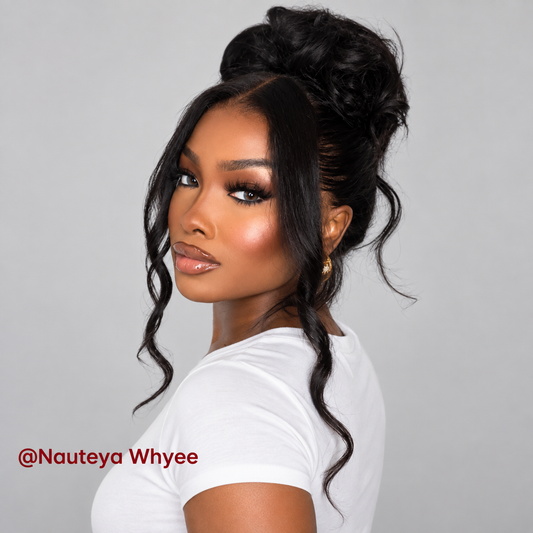
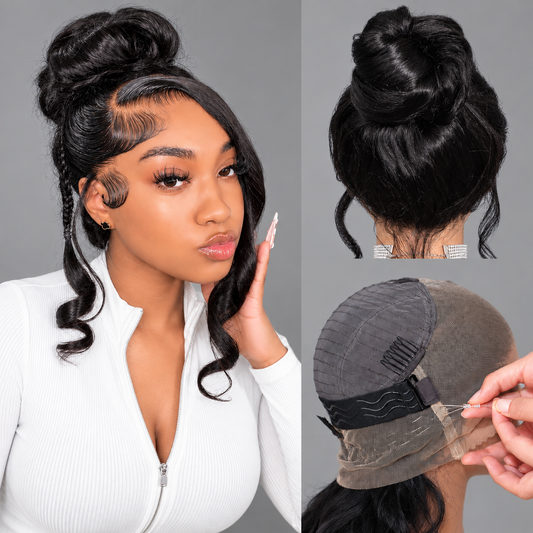


Almost every lace wig stops at the hairline. A 360 keeps going: the lace runs all the way around the perimeter, across the forehead, past both temples, behind the ears and down the nape. The whole hairline is lace, front and back.
That single difference decides who this collection is for. If you wear your hair down, a 360 is lace nobody sees. If you wear it up — a high ponytail, a bun, a French roll, anything that exposes the back of your neck — it is the construction that survives the style.
Nine units, 14 to 32 inches, 180% to 250% density. Eight are held by an Invisi Strap at the nape, one by a drawstring, and none of them needs adhesive.
What a 360 lace front wig covers, and why it changes styling
Picture the perimeter of a head. A frontal covers the front third. A closure covers the middle of the front. A 360 covers the entire ring.
Practically, that means four things become possible that are not possible on a frontal:
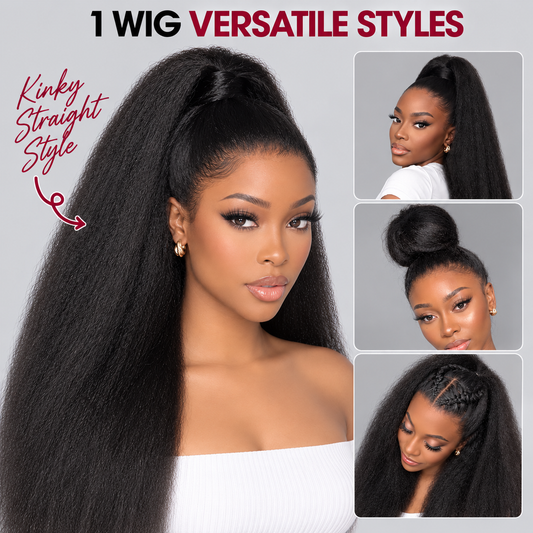
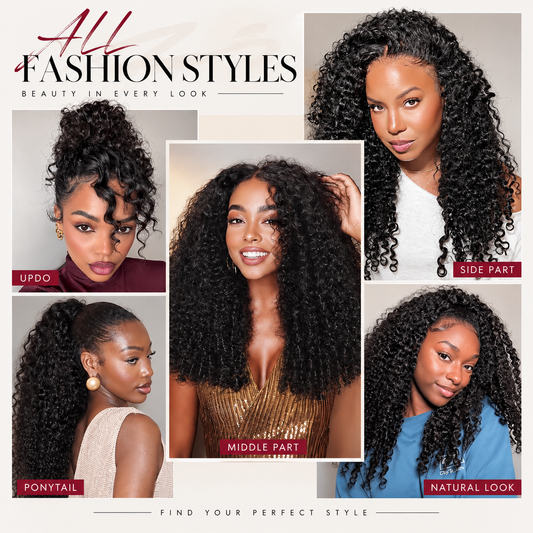
- A high ponytail. The hair can be gathered at the crown and pulled up without exposing a cap edge or a seam at the nape. This is the reason most people buy a 360 — a frontal can do a low ponytail, but the back gives it away at anything above ear height.
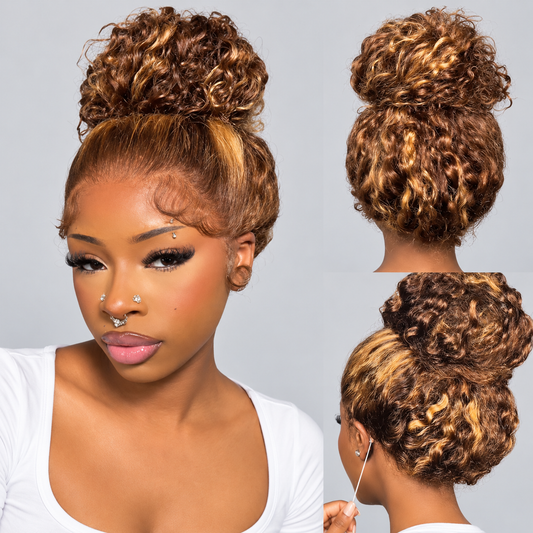
- A bun or a top knot. Same principle, higher. The nape hairline is lace, so the join at the back of the neck looks like a hairline instead of a line of stitching.
- Half-up styles. You can pull the top half back and leave the rest down, and both hairlines read correctly at once.
- Braided or twisted updos. Sectioning hair and pinning it exposes the perimeter; on a 360 the perimeter is finished.
The trade is coverage and heat. There is more lace against your skin — around the ears and down the nape — so a 360 is warmer than a frontal and takes slightly longer to fit, because there is more edge to lay down. On a glueless build with a strap, that fitting time is close to nothing; if you bond the perimeter, it is the most labour-intensive option in the store.
360 lace front wig: the nine units
The collection splits cleanly by texture family.
Straight and body wave are the plainest builds here. The straight glueless 360 is built for the high bun — pre-plucked, face-framing, with an invisible strap at the nape. The body wave version has more movement and hides a ponytail band better.
Yaki body wave is the outlier: the one unit that runs to 32 inches, and the one offered at 250% density. It uses an Invisi-Drawstring rather than a strap, which lets you cinch the whole perimeter tighter than a fixed strap allows. If your head is between sizes, or if a strap has ever left a ridge at the nape, this is the fit that solves it.
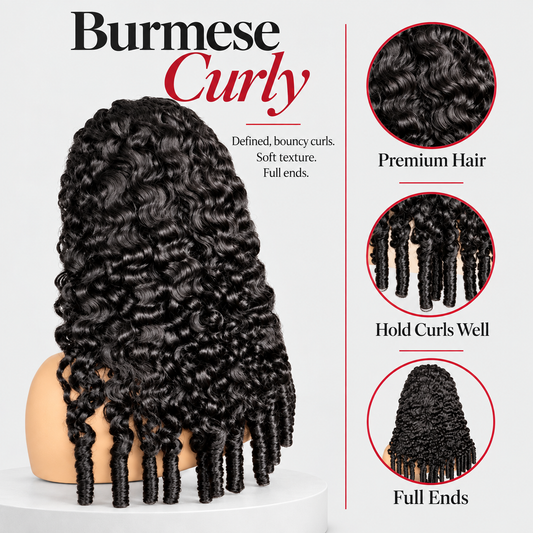
Curls and coils fill the middle of the collection: Burmese curly with 4C edges, a second Burmese curly in HD, kinky curly with 4C edges, and a highlight ombre deep wave. The 4C edges matter on an updo: they are the short hairs at the perimeter that would otherwise break the line at the nape when the hair is pulled up.
Kinky straight and deep wave complete the set: kinky straight and deep wave, both pre-cut and bleached at the knots.
Invisi Strap or drawstring: which fit
Eight units use an Invisi Strap, one uses an Invisi-Drawstring.
A strap is fixed-length on each side with an adjustable buckle. You set it once, and every wear after that is the same fit. It is faster and more predictable.
A drawstring runs around the whole perimeter and gathers. You pull it tight, tie it, and the cap conforms to your head. It handles a head that is between standard sizes, or a shape that a strap cannot hold flat at the nape. The trade-off is that it takes two hands and a mirror for the first few wears, and an overtightened drawstring will pull the front edge back off your hairline.
Neither requires adhesive. On a 360, glueless is not a compromise the way it is on a bonded frontal — the strap or drawstring does the work the glue would have done, and there is no perimeter to melt down.
360 density: 180%, 220% and 250%
Most of the collection sits at 180% or 220%. Only the yaki body wave offers 250%.
What separates the units at a given length is the texture, not the size: a curly unit uses more hair than a straight one of the same length because the curl is set on the hair rather than left as it grew. The highlight ombre adds the colour work on top of that.
For an updo, 180% is usually the better buy. A ponytail or a bun gathers the hair into a smaller volume, so the density at the crown reads higher than it does when the hair is down — 220% in a top knot can look bulbous. 220% is the choice if you mostly wear it down and want the extra body at the ends.
HD, skin lace, transparent: what the nine use
Five units are listed as HD or skin lace, four as transparent, and one as skin lace with 4C edges.
HD is the fine mesh with small knots — it disappears at the perimeter and does not show a grid when the hair is parted. Skin lace is the same approach pushed further: a thinner, softer material coloured to read as scalp, used at the hairline where a hard edge would show most. On a 360, the perimeter is longer than on a frontal, so the material difference is more visible in total than it would be on a front-only unit.
Transparent lace is the standard option: marginally more visible at the edge, considerably more durable. On a 360 that you plan to pull up and down repeatedly, durability counts — the perimeter takes more handling than a frontal edge does, because every updo pulls on it.
Wearing a 360, and keeping the perimeter intact
- Fit the back before the front. Set the strap or drawstring at the nape first, then bring the front edge to your hairline. Doing it the other way round drags the front out of place.
- Never lift the unit off by the front edge. Take it from the nape. The perimeter lace is the weakest point and the one that needs the most care.
- For a high ponytail, gather at the crown rather than the mid-back. Gathering low pulls the nape lace upward and lifts the edge.
- Use a soft, seamless band or a silk scrunchie. A tight elastic will mark the lace and leave a crease that does not recover.
- Wash every 10 to 15 wears with sulfate-free shampoo, and dry on a stand so the perimeter dries flat rather than curling up.
- Store on a stand, not folded. A 360 folded in half creases exactly where the nape lace runs.
- Heat below 180°C / 350°F. Colour is possible on all nine; bleach is a professional job, particularly on the skin lace units.
If you never wear your hair up, a 360 is more lace than you need — the 13x6 lace front gives the same parting freedom at the front with a solid back, and less lace to maintain. If you want the updo option but not the full ring, the 13x4 frontal handles a low ponytail and a half-up. The 360 is for the styles that expose the back of the neck, and nothing else does those.
360 Lace Front Wigs: frequently asked questions
What is the difference between a 360 lace wig and a lace front?
A lace front covers the forehead and stops at the temples. A 360 carries lace all the way around the perimeter — forehead, temples, behind the ears and down the nape. That is what allows an updo: with the nape hairline finished, a ponytail or bun does not expose a cap edge.
Can a 360 lace wig be worn glueless?
Yes, and all nine here are built that way. Eight are held by an Invisi Strap at the nape and one by an Invisi-Drawstring. No adhesive is needed for daily wear, which also means no perimeter to melt down and no removal routine.
What affects the price of a 360 lace front wig?
Length and density, with one structural note: most of the range sits in the mid lengths, and the yaki body wave is the one unit that runs past 26 inches. Long units at 250% density carry the most hair.
Which styles need a 360 rather than a frontal?
A high ponytail, a bun or top knot, a French roll, a half-up style, or any braided updo that exposes the back of the neck. If you wear your hair down most of the time, a 360 is more lace than you need.
What is an Invisi Strap?
An adjustable strap that runs across the nape inside the cap, hidden under the hair, with a buckle on each side. It holds the unit without adhesive and gives the same fit every wear. The drawstring version gathers the whole perimeter instead, which suits a head between standard sizes.
Is a 360 lace wig hotter than a frontal?
Yes. There is more lace against the skin — around the ears and down the nape — so it traps more warmth. A glueless build with a strap keeps it as cool as a 360 can be, but in a hot climate a 13x6 frontal will be more comfortable.