
-
Regular price $109.00Regular priceUnit price per
$155.71Sale price $109.00 -
Regular price $109.00Regular priceUnit price per
$155.71Sale price $109.00 -
Regular price $116.00Regular priceUnit price per
$165.71Sale price $116.00 -
Regular price $116.00Regular priceUnit price per
$165.71Sale price $116.00 -
Regular price $78.96Regular priceUnit price per
$112.80Sale price $78.96 -
Regular price $116.00Regular priceUnit price per
$165.71Sale price $116.00 -
Regular price $109.00Regular priceUnit price per
$155.71Sale price $109.00 -
Regular price $119.00Regular priceUnit price per
$170.00Sale price $119.00
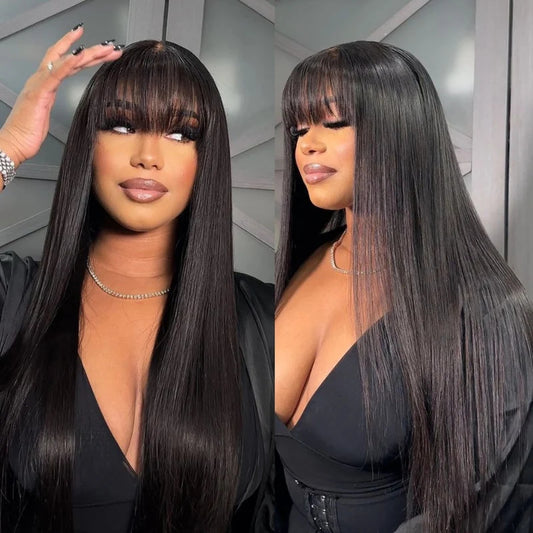


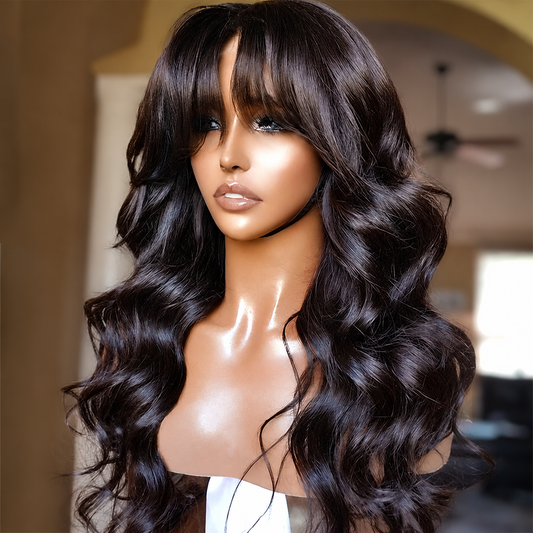

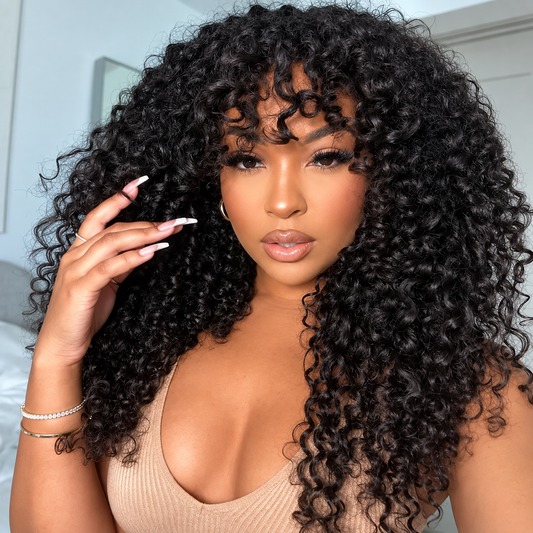

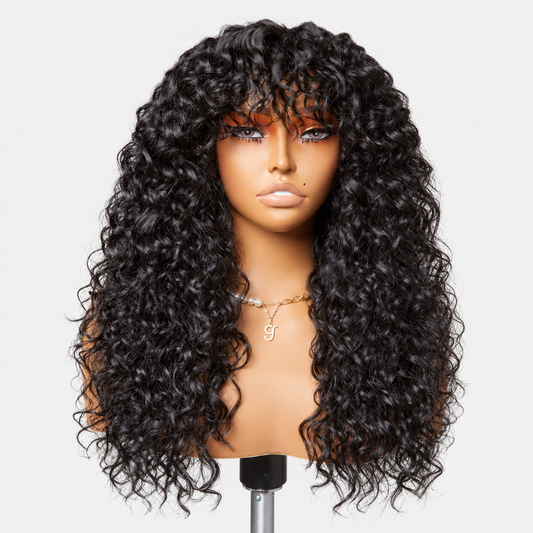


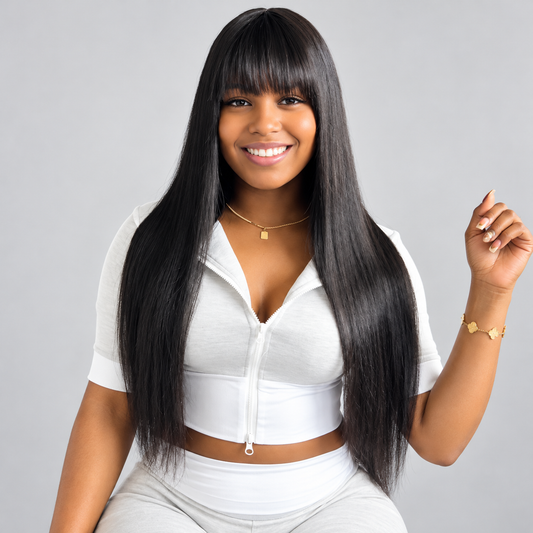

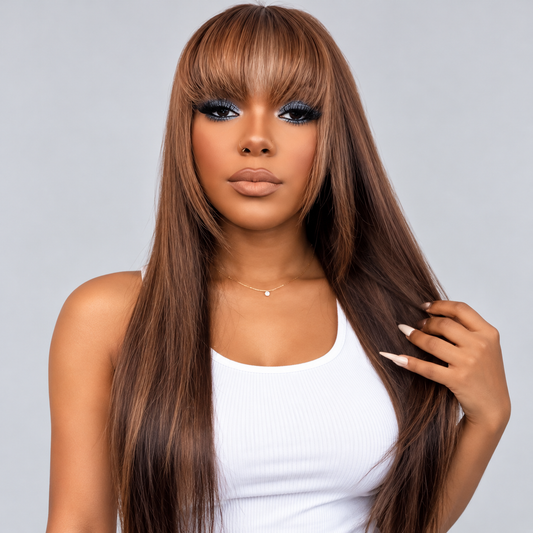
A wig with bangs solves the one problem every lace wig has: the hairline. There is no lace to blend, no knots to bleach, no edge to melt. The fringe hangs over the front of the cap and the join disappears behind it. Everything that usually takes twenty minutes on a first wear takes none.
Beluck stocks eight of them, from a short pixie to 28 inches at 250% density. All are 100% human hair on a 2x4 lace base, 14 to 28 inches, in straight, yaki straight, body wave, deep wave and two curl patterns. All eight arrive ready to wear.
What the 2x4 lace does when bangs cover it
On a normal lace front, the lace is the product. You buy HD mesh because the hairline is on show, and you spend the morning making it invisible.
On a wig with bangs, the lace is structural. Two inches across and four inches deep, it sits directly under the fringe and holds the first row of knots. Nobody sees it. What it gives you is a flat, breathable front that lies against the forehead without a bulky seam, and enough of an edge that the fringe falls from a natural direction rather than standing up off a cap.
That changes what you should care about. Lace transparency stops mattering. Knot bleaching stops mattering. What matters instead is the density of the fringe itself, whether the cut sits above or below the brow, and whether the cap at the front is thin enough to lie flat under a hat or a headband.
Every unit in the collection is sold as throw-and-go, put-on-and-go or ready-to-wear: an adjustable strap and no adhesive. Since the hairline is covered, there is nothing to glue down anyway. If you have never worn a wig, this is the shape where the learning curve is flat.
Wig with bangs, human hair: what the fringe changes
A synthetic fringe is the giveaway. It clumps, it holds a kink where it was folded in the bag, and it will not take a bend from a curling iron. Human hair fringe behaves like your own: it can be trimmed, thinned, side-swept, curled under, or straightened flat.
That matters more than it sounds, because the fringe is what people look at. It frames the eyes and sits at the centre of the face. A fringe that reads as plastic ruins an otherwise good unit, and a fringe you can restyle rescues a thin one.
Two practical notes. First, cut less than you think — trim a few millimetres at a time with the unit on your head, because a fringe that is too short cannot be undone. Second, if you want a side-swept fringe, buy a straight or yaki unit and train it with heat; a pre-cut blunt fringe has already been cut to sit straight down.
Wig with bangs from 14 to 28 inches
Length runs 14 to 28 inches, at 180% or 250% density. Because the fringe hides the front, the length you choose is really about the back and sides, and about how the unit sits on your shoulders.
| Length | Falls to | Suits |
|---|---|---|
| 14 in | Collarbone | Short bob with a fringe |
| 18 in | Shoulder | Everyday wear |
| 22 in | Mid-chest | Long without weight |
| 28 in | Waist | Statement length |
At 14 inches the fringe and the ends are close together, so the unit reads as one short cut. Past 22 inches the weight of the hair starts to pull the fringe forward and flatten it against the forehead; 250% density holds its line better at that length, which is why the long units are listed at both densities.
Five wig with bangs textures, from straight to finger coil
Five textures here, and the choice is mostly about the fringe.
Straight and yaki straight give the crispest fringe — a clean, flat line across the brow that stays put. The straight 2x4 throw-and-go and the yaki straight both cut a blunt fringe that sits flat. Yaki adds a slight texture that makes the fringe look less like a curtain and more like hair that has been blow-dried.
Body wave is the easiest to live with: the fringe can be worn straight or nudged into a soft bend, and the body of the hair stays manageable on day three. The body wave version is the one to take if you are unsure.
Curls are the harder case. A shaggy curly or a deep wave gives a fringe with movement, which reads younger and more relaxed, but a curly fringe needs product to keep its shape and will drop in humidity. The finger coil takes that furthest: defined coils from the fringe down, and the most styling work of the eight.
The pixie cut wig with bangs, and the one unit that is not 14 to 28
Seven of the eight are built on a length-and-density ladder. The eighth is different: a short pixie cut with bangs, offered in natural colour, 4# and 99J rather than in lengths.
It is the shortest unit in the collection, and the one place where colour is the choice instead of length. A pixie sits above the ear, so there is no weight at all and the fringe is proportionally the dominant feature — which is exactly why a fringe works on a pixie and looks wrong on a long unit that has been cut short at the front.
The 4# brown and 99J burgundy are on trend and photograph well; natural black is the safe one. If you have been thinking about going short but are not ready to cut, this is the simplest way to find out whether the shape suits your face.
Density: 180% or 250%
Two densities: 180% and 250%. At the same length, 250% is visibly thicker through the fringe, which is the part that shows.
180% is normal fullness. On a fringe unit it is the better choice for most people, because the fringe is a small section of hair and doubling its density makes it stiff — a 250% fringe tends to sit forward in one piece instead of separating. 250% earns its place at 24 inches and beyond, where the extra volume keeps the unit from looking thin at the ends, and on the yaki and curly textures where volume is the point.
The chocolate brown layered yaki carries both the colour and the layer cut on top of the density, which makes it the most specified unit in the collection.
Wearing a fringe unit, and keeping it sharp
- Put the unit on and pin the back before you touch the fringe. Cutting a fringe on a unit that is sitting too far forward is how people end up with a fringe above the brow.
- Trim dry, not wet. Human hair fringe shrinks as it dries and a wet cut will end up short.
- Train the fringe with a round brush and low heat — 160°C is enough. Hold it against the forehead for a few seconds while it cools; that is what sets the curve.
- Wash every 10 to 15 wears with sulfate-free shampoo, and keep conditioner off the fringe. Conditioner makes it separate and hang in strings.
- At night, wrap the fringe flat with a silk scarf or pin it in a loose bend. Sleeping on it loose is what makes it kink.
- If you want a lighter fringe later, ask a stylist to thin it rather than shorten it. Removing bulk is reversible; removing length is not.
If you would rather see the hairline and wear the part exposed, the 2x6 closure and 13x4 lace front collections are the opposite approach: less coverage on the forehead, more work on the edge. And if you want the fringe look without a fringe cut, the curtain bangs collection sits between the two.
Wig With Bangs: frequently asked questions
Do you need to pluck or bleach the lace on a wig with bangs?
No. On a 2x4 wig with bangs the lace sits behind the fringe, so the knots are never visible. Pre-plucking and bleaching are only worth paying for when the hairline is exposed, which is not the case here.
Can the bangs be trimmed or restyled?
Yes. All eight units are 100% human hair, so the fringe can be cut, thinned, side-swept or curled with heat below 180°C. Trim dry and a few millimetres at a time — human hair fringe shortens as it dries.
What affects the price of a human hair wig with bangs?
The same two factors as everywhere else: length and density. The short pixie cut is the entry build; the long layered units at 250% density carry the most hair and sit at the top of the range.
Is a wig with bangs easier to wear than a lace front?
Simpler, yes. There is no hairline to melt down and no edge to blend, and all eight units are glueless with an adjustable strap. What you cannot do is change your parting or wear the hair pulled back off the forehead.
What length should I choose for a first wig with bangs?
18 inches at 180% density. It falls at the shoulder, which keeps the fringe sitting flat, and the density is heavy enough to hold a blunt line without the stiffness that 250% gives a fringe.
Can I wear a wig with bangs in summer?
That is what the 2x4 base is for. There is no lace across the forehead to trap heat under the fringe, and the cap behind the lace is breathable. The pixie cut is the coolest option in the collection.